
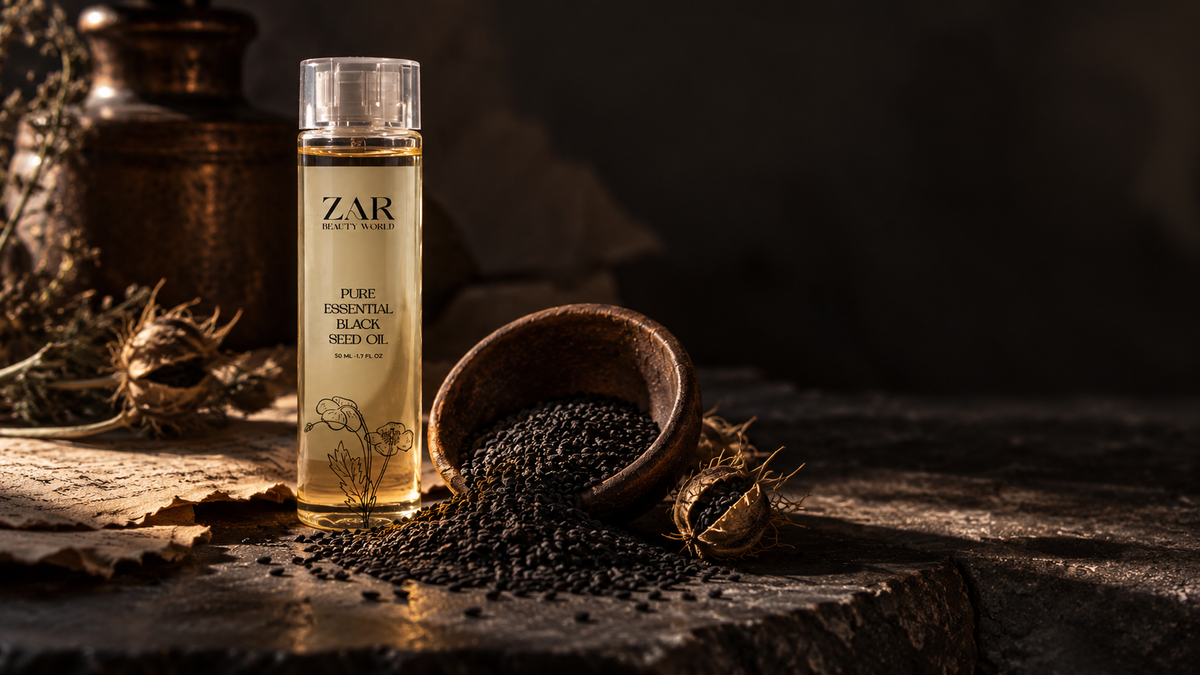
In Arabic it is habbat al-barakah — the seed of blessing. In South Asia it is kalonji. English-speaking shops call it black cumin, black caraway, or nigella, and botanists call it Nigella sativa, which is the only name that is actually correct.
When one small black seed collects that many names across that many languages, it tells you something. Nobody bothers to name a thing twelve times unless twelve different groups of people independently found it useful.
A seed with a very long résumé
Black seed has been in continuous human use for thousands of years. It has been found in ancient Egyptian burial contexts. It appears in classical Greek and Islamic medical writing. It has been pressed into oil, ground into paste, chewed with honey, baked onto bread, and prescribed for an almost comically wide range of complaints — which is both its reputation and its problem.
Any remedy claimed to help with everything should be treated with suspicion about anything. So let us separate what the seed has earned from what has been projected onto it.
What black seed oil is genuinely good at, topically
Pressed black seed oil is dark, assertive, slightly bitter-smelling, and chemically interesting. Its main characters are thymoquinone and a set of unsaturated fatty acids, and the properties that matter for skin are fairly well described: it is soothing on irritated skin, it helps support the skin barrier, and it has a long traditional record of use on flaky, inflamed, stubborn patches.
In practice, people reach for it for three things.
Reactive, irritated skin. The kind that goes red at the smallest provocation and stings when you apply anything new. Black seed is often tolerated where lighter, fresher-smelling oils are not.
Dry, scaly patches. Elbows, hairline, the sides of the nose, that one spot on your shin that never quite settles. It is a heavier oil and it stays put, which is exactly what those areas need.
Scalp comfort. Flaking, tightness, the itch that makes you scratch at your desk. Warm a little, part the hair, apply to the scalp itself rather than the strands, leave it an hour, wash out.
Our pure essential black seed oil is a cold-pressed single oil, which means you are getting the seed and nothing arranged around it.
What it is not
It is not a treatment for a medical skin condition. If you have eczema, psoriasis, or persistent dermatitis, black seed oil may well make your skin more comfortable, and it is not a substitute for seeing a dermatologist.
It is not a cure for hair loss. It is a good scalp oil. Those are different sentences.
And it is not an oil to take internally on the basis of a blog post. The traditional ingestion of black seed is real and ancient, and it also interacts with the body in ways that matter if you are pregnant, breastfeeding, on blood-thinning or blood-sugar medication, or heading into surgery. Our oils are made for your skin and hair. For anything you swallow, ask a doctor, not a beauty brand.
The honest problem: it smells like itself
Black seed oil is not a pretty smell. It is dark, peppery, faintly bitter, a little medicinal. People who love it love it the way they love strong coffee. People who do not will not be persuaded by an adjective.
We have deliberately not perfumed it. Covering that smell means adding fragrance to a single-ingredient oil, which defeats the point of buying a single-ingredient oil.
Two ways round it, if the scent is the barrier:
- Use it at night. By morning it is almost entirely gone. This is the simplest answer and it works for most people.
- Blend it down. A few drops of black seed into a tablespoon of a quieter carrier — coconut or almond — keeps most of the benefit and softens the smell considerably.
Why we keep the difficult ingredients
It would be commercially easier to drop black seed. It does not photograph beautifully. It does not smell like a candle. It does not have the easy appeal of rose or the instant recognition of coconut.
We keep it because our offices in Dubai and Beirut sit in parts of the world where this seed never went out of fashion, and because a brand built on plants and herbs does not get to only stock the photogenic ones.
Some ingredients earn their place over centuries rather than seasons. Twelve names in twelve languages is a decent indication of which ones those are.
Browse the full range of face oils — all vegan, cruelty-free, and made in our Canadian facility.