
Here is what a tan actually is, and it is worth knowing before you decide how much of one you want.
When ultraviolet light reaches your skin, specialised cells called melanocytes produce melanin and distribute it upward towards the surface. Melanin absorbs and scatters UV. The darkening you see is your skin building a shield, after the fact, in response to exposure it has already taken.
Which means a tan is not an achievement. It is a receipt.
That is not an argument against sun. It is an argument for understanding what you are participating in, because the difference between a good relationship with the sun and a damaging one is almost entirely a matter of informed timing.
What tanning oil does, precisely
Let us be exact, because this category is full of vagueness.
Tanning oil is not sun protection. Unless a product carries an SPF rating, it offers no meaningful protection, and oil on skin can increase UV transmission into the upper layers rather than reduce it. If you take one sentence from this piece, take that one.
What it genuinely does is condition. Sun, salt, chlorine and wind are all dehydrating. Skin that is dry tans unevenly and peels sooner, and peeling is what takes a tan away. Well-conditioned skin holds colour more evenly and for longer — not because the oil created pigment, but because the skin surface stayed intact long enough to show it.
It also makes skin look better immediately. Oil smooths the surface so light reflects more evenly, which reads as glow. That effect is real, instant, and purely optical.
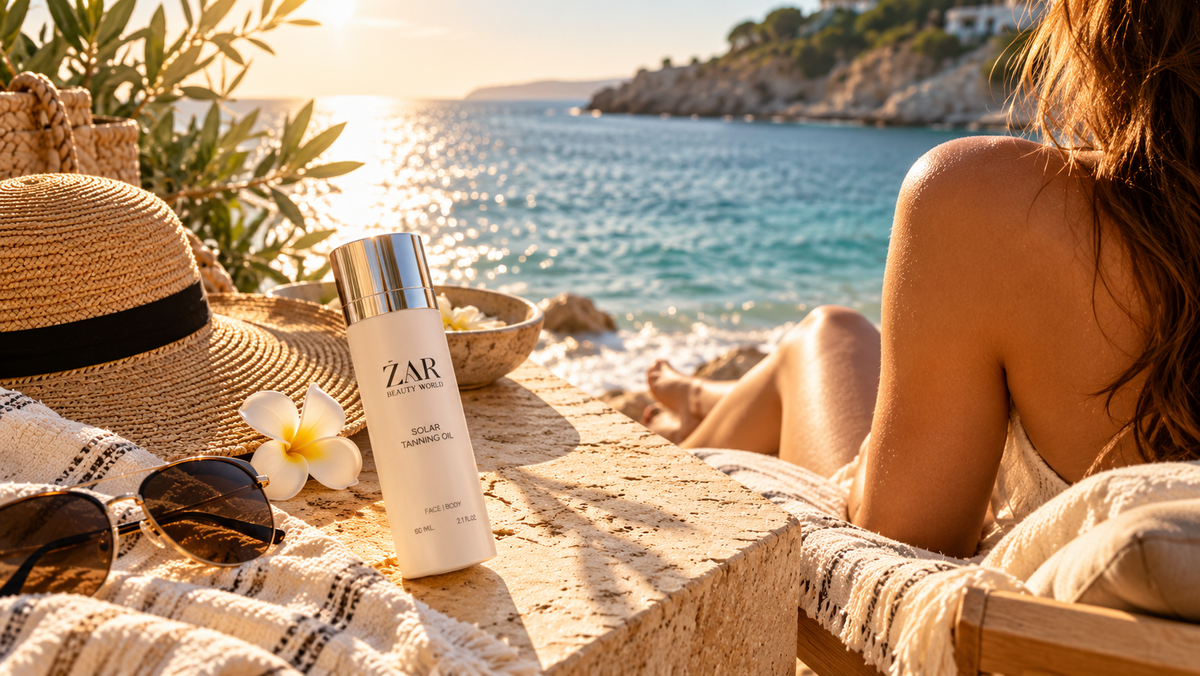
Our solar tanning oil and island tanning oil are conditioning oils for skin that is going to be in the sun. They are not a shortcut and they are not a substitute for sunscreen, and we would rather tell you that than imply otherwise.
The way to do this without regret
Sunscreen first. Always. Broad-spectrum, properly applied, reapplied every two hours and after swimming. Then oil, if you want the conditioning and the finish. In that order, with a few minutes between. Yes, you will still tan — no sunscreen blocks everything, and the tan you get through SPF is slower, more even, and lasts considerably longer.
Avoid the middle of the day. UV peaks roughly between ten and four. Early morning and late afternoon give you light with a materially lower burn risk, and better light to be in anyway.
Build slowly. Twenty minutes, then thirty, then forty, over days rather than hours. Gradual exposure lets melanin production keep pace. The alternative — four hours on day one — produces a burn, and a burn is not a tan. It is an inflammatory injury, and it will peel off, taking any colour with it.
Know your own skin. Very fair skin that freckles and burns has limited melanin capacity, and no amount of patience changes that. Pushing past your capacity does not produce colour; it produces damage. This is genetics, not discipline.
Hydrate from both directions. Water through the day, and oil or cream on skin every evening after sun exposure. The evening application is what decides whether you are still golden in two weeks or flaking in five days.
Cover the parts that always get missed. Ears, the tops of the feet, the back of the neck, the parting of the hair, the strip under the edge of a swimsuit. These are where burns happen and, over decades, where damage shows up first.
The unglamorous truth
Cumulative UV exposure is the single largest driver of visible skin ageing — the texture, the loss of elasticity, the uneven pigmentation. More than diet. More than genetics, for most people. Considerably more than whatever serum is currently being advertised at you.
And it is also the main modifiable risk factor for skin cancer, which is a sentence a beauty brand is not supposed to put in a post about tanning oil. We are putting it in anyway, because you are an adult and you can hold two facts at once.
Sun is also genuinely good for you in moderate amounts. It regulates sleep, it lifts mood, it is involved in vitamin D synthesis, and sitting in warm late light is one of the great free pleasures of being alive. The goal has never been avoidance. It is dosage.
A better way to think about it
Stop aiming for a colour and start paying attention to the light.
The best sun of the day is at the beginning and the end. It is warmer, softer, lower, kinder to your skin, and incidentally far more beautiful. The hours everyone fights for — eleven to three, flat and overhead and harsh — are the hours that cost the most and give the least.
Protect yourself properly, condition your skin, go out early or late, and let whatever colour arrives arrive. It will be more even, it will last longer, and in thirty years your skin will be able to tell the difference.
A tan fades either way. What you are really choosing is what gets left behind.
Browse our tanning oils and body oils. Always use a broad-spectrum sunscreen — our oils condition skin, they do not protect it.