
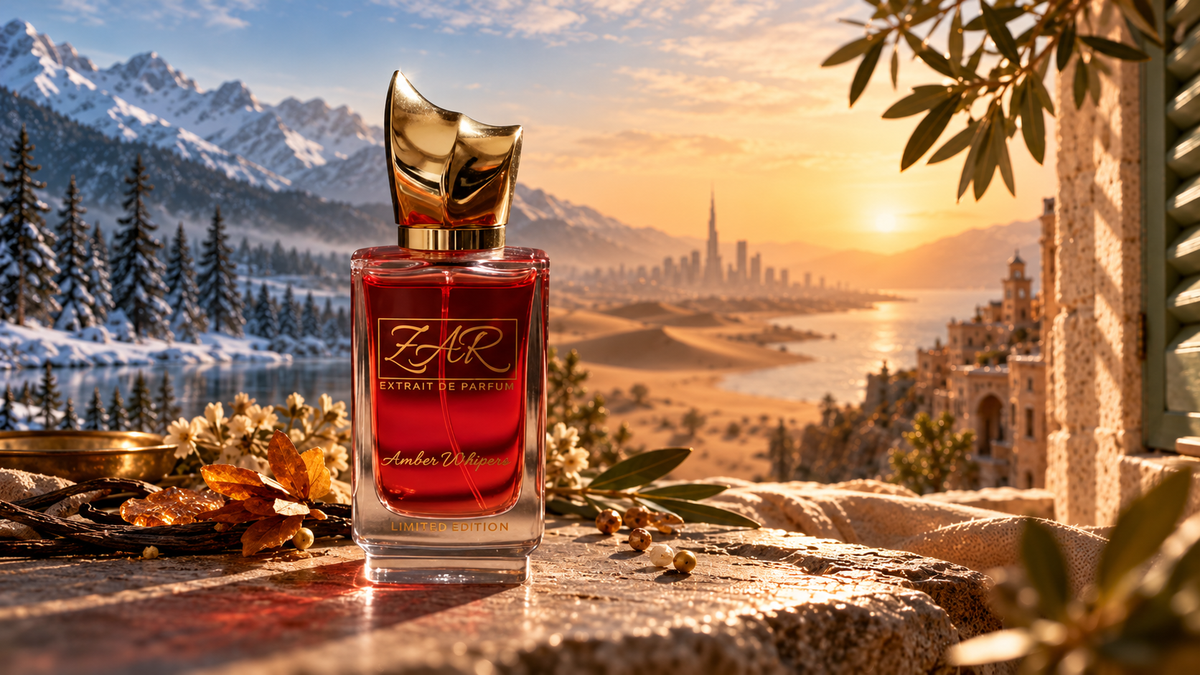
There is a moment in the life of this bottle that nobody photographs.
It happens in a cold room. The composition has been blended, it has been left to rest, and now it is simply waiting. Outside, it is a Canadian kind of cold — the sort that makes glass feel thinner than it is. Inside, something deeply warm sits perfectly still in the dark: resinous, golden, patient, smelling of a part of the world a very long way from this one.
That contradiction is the whole company, really.
First, what amber actually is
Worth clearing up, because it is the most misunderstood word in perfumery.
Amber is not an ingredient. There is no amber flower, no amber tree you tap. The fossilised resin you find in jewellery is a different material altogether and is not what is in the bottle.
Amber in perfume is an accord — a construction. It is an effect built from several materials working together, traditionally resins and balsams with a sweet, soft weight behind them. Perfumers have been assembling versions of it for well over a century, and no two houses build it the same way. Which means amber is less like a colour you select and more like a chord you voice: the same three notes arranged differently produce something warm and enveloping, or something sticky and overbearing.
Getting it right is genuinely difficult, and it is the reason a good amber costs what it costs.
Note for ZAR: this piece would be materially stronger with the real specification. Send me the note pyramid for Amber Whisper — top, heart, base — along with the concentration, bottle size in ml, your tested wear time and the edition size, and I will write them in. I have deliberately not invented any of them for a limited-edition fragrance you are selling.
Canada gives it discipline
Our manufacturing facility is in Canada, and that is not an accident of geography. It is a decision about standards.
Cold climates are unkind to sloppy composition. A fragrance built on hope rather than chemistry discolours, separates, or simply goes flat — and the heavier and more resinous the construction, the more there is to go wrong. Amber accords are among the most demanding things to stabilise precisely because the materials that give them their depth are the materials most inclined to misbehave over time.
Blending in Canada means every batch has to survive a journey from a cold room to a dressing table in Dubai in August and still be recognisably itself in month ten. Not approximately itself. The same.
It also means a particular kind of paperwork — ingredient traceability, batch records, allergen declarations. The unglamorous spine of the business, the part nobody puts on a box because it does not photograph well. Our products are vegan and cruelty-free, and the reason we can state that plainly is that somebody in Canada can produce the document that proves it.
Canada is where the composition learns to behave.
Dubai gives it endurance
Our sales office in Dubai sits in a city with an unusually honest relationship with fragrance.
In much of the world, perfume is a finishing touch — something applied last, lightly, on the way out. In the Gulf, scent is architecture. It is layered deliberately: oil first, then spray, then the smoke of oud worked through fabric. And it is expected to last from morning until long after midnight. A fragrance that fades in two hours is not considered subtle there. It is considered broken.
Working from Dubai changes what you consider acceptable. It is why this composition is built for the back half of its life rather than the first ten seconds on a blotter. Anyone can make an opening that impresses on paper. The harder and more expensive thing is a base that is still doing something graceful six hours later, on warm skin, in humidity.
Amber happens to be unusually good at this. Resinous, weighty constructions sit close to the skin and release slowly, which is exactly the behaviour a Gulf wardrobe asks for. Dubai did not give us the amber. It gave us the standard the amber had to meet.
Beirut gives it restraint
And then there is Beirut, where our other sales office sits, and where almost nobody will tell you something is nice merely to be polite.
The Levant has a long, stubborn, inherited relationship with warm scent. Resin burned in a house before guests arrive. Orange blossom in spring, when a whole street smells of it for a fortnight and then does not again for a year. Rose water kept in the fridge door. None of it was marketed to anyone. It simply persisted, tested across generations, with no advertising budget behind it at all.
That culture is a brutal editor. It has smelled a great deal of amber over a very long time, and it has no patience for the version that announces itself from across a room and then has nothing further to say.
Beirut is why this fragrance is called a whisper.
The whisper is a technical decision
This is the part most worth understanding, because it explains how the fragrance will behave on you.
Perfumery distinguishes between two things that casual conversation lumps together. Projection is how far a fragrance throws — how much of the room it occupies. Sillage is the trail it leaves, the shape of it in the air as you move. A fragrance can be enormous in projection and forgettable in character, and a quiet fragrance can have beautiful sillage.
The easy commercial move with amber is to maximise projection. Push the sweetness, push the resin, make it fill a space. It sells well, and it is also why a lot of amber fragrances are exhausting after an hour — both for the wearer, who stops being able to smell it, and for everyone within three metres, who cannot stop.
Amber Whisper is built the other way. Close to the skin, slow, warm rather than loud. The intention is that it is discovered rather than announced — something people notice when they come near, not when you arrive.
That is a harder thing to construct and an easier thing to live with. It is also why “understated” is doing real work in the product description rather than sitting there as an adjective.
How to wear it
Four things that genuinely change the result.
- Cool skin, not warm. Apply before you dress and before you go anywhere hot. Heat accelerates the opening and you lose the top of the composition in the first few minutes.
- Touch, do not rub. Rubbing your wrists together is the most common mistake in perfume and a real one — the friction and heat break up the top notes and rush the whole development, so you arrive at the base too early.
- Amber belongs on fabric as much as on skin. This is the one genuine advantage of the season it was built for: wool, scarves, a coat collar. A resinous composition will still be faintly present on a jacket a week later, and that is a feature rather than a residue. Spray into the air and walk through it rather than directly onto silk or any fine fabric.
- Keep it out of the bathroom. Heat and humidity degrade fragrance faster than anything else, and a bathroom windowsill is the worst place in the house. A drawer, upright, capped, away from light.
And give it an hour before you judge it. The first fifteen minutes are the top notes burning off; what you are actually buying is what happens after that.
Timeless elegance in every drop
We use that line often enough that it would be easy to read as decoration. It is not. It is a specification.
Timeless means we are not reformulating every eighteen months to chase whatever note is in season. Elegance means restraint — the discipline to stop building before the composition starts shouting. In every drop means consistency, which is the hardest and most expensive promise on the list: the last millilitre has to be the same as the first, and the ten-thousandth bottle the same as the first one we ever poured.
Three cities, one bottle, one promise. There is no other story hiding behind it.
Amber Whisper is part of our limited-edition 4 Seasons Collection. Limited edition means limited edition — we cannot guarantee a restock.
Discover Amber Whisper, or explore the full 4 Seasons Collection. New here? Use code ZARGLOW for 15% off your first order, and join ZAR Circle to earn Glow Points. Read more about where we make things.