
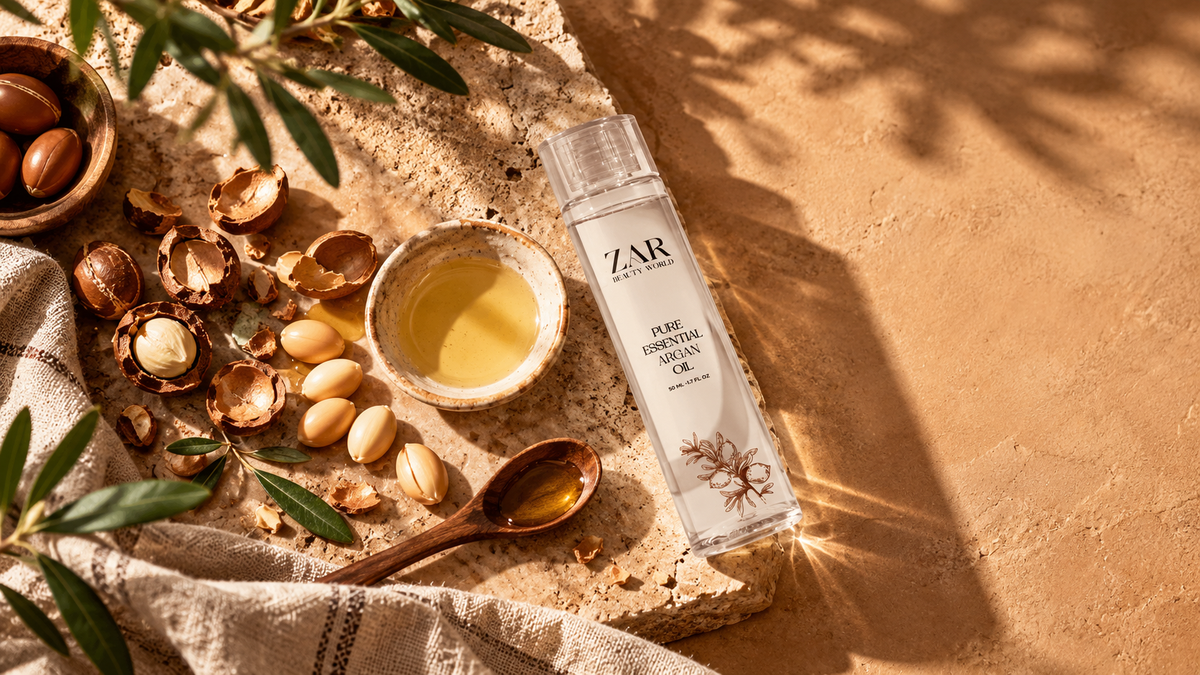
An argan tree is a deeply unreasonable business proposition.
It grows slowly. It takes years - not months, years - before it will give you fruit worth collecting. It thrives in semi-arid ground where almost nothing else wants to live, sends roots down further than seems polite, and then produces a fruit with a kernel locked inside a shell so hard that for most of the oil's history, the only reliable way to open it was a stone and a human hand.
Industrial agriculture hates this tree. Which is exactly why the oil is worth something.
The shell is the whole story
Most oil crops have been engineered towards convenience. Easier hulls, bigger yields, shorter cycles, machines that can process a tonne before lunch. The argan held the line. Its shell is famously resistant to mechanical cracking without damaging the kernel inside - and a damaged kernel means heat, and heat means a flatter, duller oil.
So the work stayed human. Women's cooperatives across the argan region still crack by hand, kernel by kernel, hour after hour. It is slow, skilled, physically demanding work, and the oil that comes out the other side carries a cost that reflects it.
When you see argan oil priced like sunflower oil, that is the tell. Something in that chain was rushed, cut, or quietly replaced.
Why cold-pressed is not a marketing word
There are two argan oils in the world and they are not the same thing.
Roasted argan is the culinary one. The kernels are toasted first, which gives a nutty, almost hazelnut smell and a darker colour. It is delicious on bread. It is not what you want in your hair.
Cold-pressed argan is the cosmetic one. No roasting, no heat beyond what the press itself generates. The colour is paler, the smell is faintly green and slightly nutty, and the fragile things in the oil survive — the vitamin E, the unsaturated fatty acids, the small compounds that go first when you apply heat.
If an argan oil smells strongly toasted, somebody sold you lunch.
What it actually does for hair
Let us be plain, because this is the part where beauty writing usually loses its nerve.
Argan oil does not grow hair. Nothing you pour on the outside of a hair fibre can grow it, because hair is produced in the follicle, below the surface, and the strand itself is not alive.
What argan oil does is protect what you already have. It is relatively light for an oil, it absorbs reasonably well rather than sitting on top, and it reduces the roughness and friction that cause mechanical damage — the breakage from brushing, towel-drying, heat styling, tying back, sleeping. For most people with dry or damaged hair, the visible improvement comes from losing less, not from gaining more.
That is a less exciting claim and a far more reliable one. Hair that breaks less looks thicker, because it keeps its length and its ends stay blunt instead of fraying.
Our pure essential argan oil sits in that job. Mid-lengths and ends, on damp hair, a few drops warmed between the palms first. Not the scalp, unless your scalp is genuinely dry — most are not.
How to use an oil that took years to make
Sparingly, is the short answer. Here is the longer one.
- On damp hair, not wet, not dry. Wet hair dilutes it and it runs off. Bone-dry hair makes it sit on the surface. Towel-damp is the window.
- Warm it first. Two or three drops in your palms, rub them together for a few seconds. Cold oil spreads badly and you end up using three times as much.
- Start at the ends and work up. Never the reverse. The ends are the oldest, driest part of the hair and they should get the most.
- Comb it through properly. A wide-tooth comb distributes far better than fingers. A comb is not an upsell; it is the difference between oiled hair and greasy roots.
- Overnight, once a week. Slightly more generous application, braid it loosely, old pillowcase, wash out in the morning.
And on skin: argan is one of the more agreeable facial oils for people who find most oils too heavy. A single drop pressed into damp skin after cleansing, at night. If your skin is oily and acne-prone, patch-test on your jaw for a few nights before committing to your whole face.
The lesson of a slow tree
There is something clarifying about an ingredient that cannot be optimised.
You can shorten almost every other step in beauty. You can speed up shipping, automate the filling line, generate a hundred product descriptions before breakfast. You cannot make an argan tree fruit faster, and you cannot talk its shell into opening more easily.
Some things take the time they take. There is a reasonable argument that those are the things worth putting on your skin.
Explore our hair oil collection, or try argan alongside bay and rosemary in a discovery kit before you commit to a full bottle.