
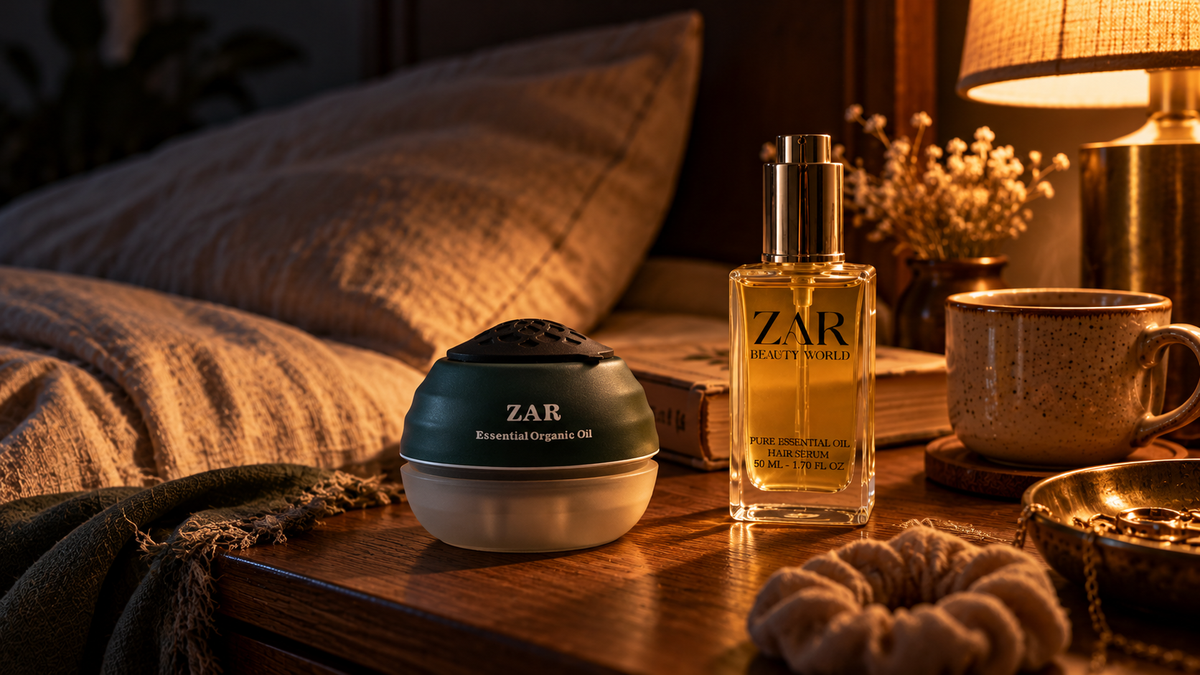
There is a gap at the end of every day that nobody has claimed.
It sits after the teeth and before the light switch. Eight minutes, ten at most. For most of us it goes to a phone, and we hand it over without noticing, and it gives nothing back.
I want to make a case for spending it on your hair instead. Not as self-care theatre — no candles required, no bathtub, no deliberate gratitude. Just a short, repeatable, physical thing that quietly compounds.
Why night, and why oil
Hair damage is mostly mechanical. It is not usually one dramatic event; it is friction, accumulated. Brushing dry hair. Towel-rubbing. Heat. Tying it in the same place every day. And, more than people realise, eight hours of a head turning against cotton.
Oil reduces friction. That is the mechanism, and it is a boring one, and it is the real one. A hair fibre with a smoothed, conditioned cuticle slides past its neighbours instead of catching on them. Less catching means less breakage. Less breakage means hair that keeps its length and holds a blunt end instead of splitting into a wisp.
Night is simply the longest uninterrupted window you have, and you are not going anywhere, so you do not need to care how it looks.
The ritual, step by step
Minute one: warm the oil. Three to five drops into your palm — hair serum if your main concern is the scalp and thinning, argan if it is dryness and damage. Rub your hands together for a slow count of ten. Warm oil spreads two or three times further than cold oil, which means you use less and distribute it better.
Minutes two and three: section, do not pile. Split your hair down the middle, then take each half forward over the shoulder. Working in two manageable halves rather than one unruly mass is the single biggest improvement most people can make. You stop missing the back, which is where damage usually lives.
Minutes four and five: ends first, upward. Press the oiled palms around the last few inches and squeeze gently, the way you would wring out a cloth without twisting. Then work upward, maybe to the mid-lengths. If your scalp is dry or flaking, take a few extra drops and use your fingertips directly on the skin — small circles, firm enough to feel it, not enough to drag.
Minutes six and seven: comb it through. This is the step people skip, and it is the step that does the work. A wide-tooth comb drawn slowly from mid-length down redistributes the oil evenly along every fibre. Fingers cannot do this. Start lower than you think you should and work up in passes.
You will feel the exact moment it stops catching. That moment is the entire point of the ten minutes.
Minute eight: contain it. A loose braid, or a loose twist pinned up. Loose is doing real work in that sentence — tension at the hairline overnight is one of the more reliable ways to cause the thinning you are trying to prevent. If you have a silk or satin pillowcase, use it. If you do not, an older cotton one you do not mind marking is perfectly fine.
And then nothing. Go to sleep. The ritual is over. It took less time than deciding what to watch.
How often, honestly
Twice a week is enough to see a difference within a month or so. Three times if your hair is coarse, dry, colour-treated or long. Every night is usually too much for fine hair and you will find yourself washing more often, which undoes the gain.
Wash it out in the morning or the next day. Oil left in indefinitely attracts dust and can leave the scalp feeling congested.
And a note on expectations, because this matters: you are not waiting for growth. Hair grows at roughly a centimetre a month regardless of what you do, and no topical oil changes that rate. What you are waiting for is retention — hair that reaches its length instead of snapping before it gets there. Give that three months before you judge it. The change is cumulative and almost invisible week to week, which is why photographs help and mirrors do not.
The quiet part
There is a secondary effect that has nothing to do with hair, and I think it is half the reason the habit sticks.
Ten minutes of slow, warm, repetitive, physical work with your hands is a very old method for telling a nervous system that the day is finished. It is the same reason people knead bread, or garden badly, or wash dishes they could put in a machine. The hands are busy and the head goes quiet.
Your hair gets the measurable benefit. You get the other one.
Build your own ritual from our hair oils and serums. New customers: ZARGLOW for 15% off, free shipping over $45.