
There is a particular kind of knowledge that never gets written down because nobody involved thought it was remarkable.
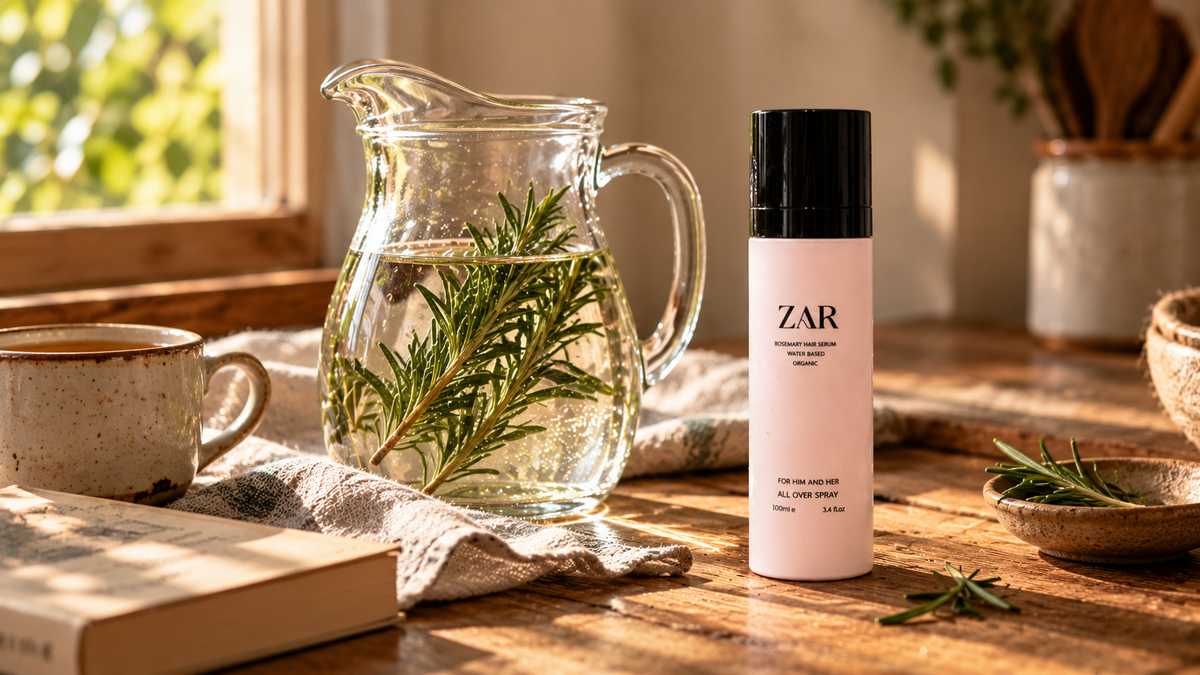
A rosemary bush by the kitchen door. A handful of sprigs in a jug of water, left on the windowsill overnight. Poured over the hair after washing, no rinse. Done because her mother did it, who did it because her mother did it, and none of them ever used the word efficacy once.
For most of the last century, that sort of thing was filed under charming. In the last decade or so, the file has been reopened.
The remedy came first by a long way
Rosemary has been in Mediterranean hair and scalp practice for a very long time. It appears in classical herbals. It travelled through Arab medicine, into European monastery gardens, into Levantine and North African households, and it stayed in all of them. It is in hair tonics from the 1800s and in grandmothers' kitchens in Beirut now.
That continuity is not proof. Plenty of traditional remedies survived for centuries and turned out to do nothing much. But survival across unrelated cultures, with no shared marketing and no commercial interest, is at least a reason to look properly.
Then the research started to catch up
In 2015, a randomised trial compared rosemary oil against minoxidil — the standard over-the-counter hair loss treatment — in people with androgenetic alopecia, over six months. Rosemary performed comparably on hair count. It also produced less scalp itching than minoxidil did.
That study is genuinely interesting and it is also one study, with a modest number of participants, and it is not the final word on anything. Since then there has been more work on rosemary's effects on circulation, on the scalp environment, and on its main aromatic compounds. The picture is encouraging and incomplete.
Here is the fair summary: rosemary is one of the better-evidenced botanical options for hair, and the evidence is still thinner than the enthusiasm. Both halves of that sentence are true and you should be suspicious of anyone who only tells you one of them.
Why it might work
The leading explanation is unglamorous and plausible. Rosemary appears to improve local blood flow at the scalp, and follicles with better circulation are better supplied. It also has a mild antimicrobial character, which helps with the flaking and low-grade irritation that make a scalp an unfriendly place for hair to grow.
Notice what is not in that explanation: hormones. Rosemary is not doing what finasteride does. If your hair loss is strongly androgenetic and progressing quickly, a botanical oil is a support, not a strategy. Go and see a dermatologist, and use the oil alongside whatever they recommend rather than instead of it.
How to use it without wasting it
Two formats, two jobs.
The oil. Our pure essential rosemary oil is concentrated. It belongs on the scalp, diluted, and massaged in — a few drops into a tablespoon of coconut or almond oil, applied in sections with the fingertips, left for at least thirty minutes, then washed out. Two or three times a week. The massage is not optional decoration; mechanical stimulation is part of why this works.
The water-based serum. Our organic rosemary water-base serum is the version of your grandmother's jug that does not need to be made fresh every night. Water-based, so it goes on a clean damp scalp and stays there without needing to be rinsed out. This is the daily one. It is also the one for people with fine or oily hair who cannot carry an oil without looking washed out.
Most people do best with both: the serum on weekdays, the oil treatment at the weekend.
Three honest cautions
- Never neat on skin. Undiluted rosemary essential oil can irritate and sensitise. Dilute it. Always.
- Patch test. Inner forearm, twenty-four hours. Rosemary is well tolerated by most people and badly tolerated by a few.
- If you are pregnant, or you have epilepsy or high blood pressure, ask your doctor first. Rosemary is a real plant with real activity, which is the whole appeal and also the reason for the caution.
Give it three months
Hair works on a slow clock. Follicles cycle over months, growth runs at roughly a centimetre a month, and anything that affects the follicle takes a full cycle to show at the surface.
Three months of consistent use, photographed in the same light at the same angle on the first of each month. That is the honest test. Four weeks of enthusiasm followed by a bottle at the back of a cupboard is how most people conclude that nothing works.
Your grandmother's advantage was never a better ingredient. It was that she did it for thirty years without ever wondering whether it was working.
Shop hair oils and water-based serums. Vegan, cruelty-free, made in Canada.